Showing posts with label Historical Fantasy. Show all posts

16 July 2012

Dust Girl by Sarah Zettel


Callie LeRoux lives in Slow Run, Kansas, helping her mother run their small hotel and trying not to think about the father she’s never met. Lately all of her energy is spent battling the constant storms plaguing the Dust Bowl and their effects on her health. Callie is left alone when her mother goes missing in a dust storm. Her only hope comes from a mysterious man offering a few clues about her destiny and the path she must take to find her parents in "the golden hills of the west": California.

Along the way she meets Jack, a young hobo boy who is happy to keep her company — there are dangerous, desperate people at every turn. And there’s also an otherworldly threat to Callie. Warring fae factions, attached to the creative communities of American society, are very much aware of the role this half-mortal, half-fae teenage girl plays in their fate.


If you’re looking for a sweet, quick read I recommend you pick up this book. Although it doesn’t have a lot of deep thinking or commentary on society Dust Girl does have a lot of history and a good bit of magic to keep things going.

The best thing about this book is the worldbuilding. From the research of the depression and the dust bowl in Kansas to the careful inclusion of the fairies, Zettel has built a wonderful world for her book to live in. Callie is a delightful character and manages to encompass all the complications of her age and race in such a difficult time. Jack also has problems with his age and his race, and he also has a harsh past, but he manages to care and is a great tour guide for Callie on her journey. The lack of romance is nice, although there is a foundation laid for a future spark to grow between them. The rest of the characters are well-written, from the Hoppers to Shake and Shimmy, but I won’t spoil them for you.

The plotting was good but not great. I liked the introduction, but it did move a bit slow. I think the reader could have caught up on things had the book started with the big dust storm. The middle of the book was great, with action happening right where it needed to and not bogged down by too much exposition. The ending, though, felt very rushed, the denouement was a bit disjointed and not in the flow of the rest of the book, and the cliffhanger was maddening.

The cover of this book, though, makes me sad. I was extremely surprised when the narrator declared that she had an African American father because of the picture on the cover. I really wish they had used a girl who was the same ethnicity as the narrator of the book, especially one that talks so much about racial issues and segregation. It’s a sad commentary on the book’s publishers.


I received a copy of this book free through NetGalley in exchange for an unbiased review.

29 June 2012

Spirit’s Princess by Esther Friesner


Himiko the beloved daughter of a chieftain in third century Japan has always been special. The day she was born there was a devastating earthquake, and the tribe's shamaness had an amazing vision revealing the young girl's future—one day this privileged child will be the spiritual and tribal leader over all of the tribes. Book One revolves around the events of Himiko's early teen years—her shaman lessons, friendships, contact with other tribes, and journey to save her family after a series of tragic events. Once again, Esther Friesner masterfully weaves together history, myth, and mysticism in a tale of a princess whose path is far from traditional.


I have loved Esther Friesner’s series on historical figures (Cleopatra and Helen of Troy) and I was very excited when I heard she was doing Japanese history next. However, after having read the books I’m not exactly sure I’d put Spirit’s Princess alongside Nobody’s Princess or Sphinx Princess. Not that it’s bad. On the contrary, Spirit’s Princess is excellent. It’s just not similar. Where Sphinx and Nobody were about girls being repressed by being forcibly married and having romance, Spirit’s Princess is about a girl learning to live in her family and her repressive culture. Spirit’s Princess also covers a much broader set of time (by my guesstimate it’s about a decade?) so there’s much more character growth and adaption.

 I loved watching Himiko learn to work with and around the rules her father and society create for her rather than fighting against them all the time. Himiko’s relationship with her mother and her father’s other wives was interesting, and I like how even-handed Friesner was with the traditional relationship and not judgmental over something that was done and made to work in the past. Instead we are shown the ups and downs of living in a family that has more than one wife and many children. I also very much liked Himiko’s relationship with her brother, Aki, but I wasn’t too happy with the portrayal of the other village girls as only jealous, conniving waifs with no interest in anything other than marriage and family. It does give the book an air of classism, as if only the ruling elite are able to broaden their minds beyond their daily life. However, this is a small complaint, and I was able to overlook it in the grander narration. I loved diving into Himiko’s life, and I can’t wait for the next book in the series!

A copy of this book was provided to me through NetGalley for free in exchange for an unbiased review.
05 March 2012

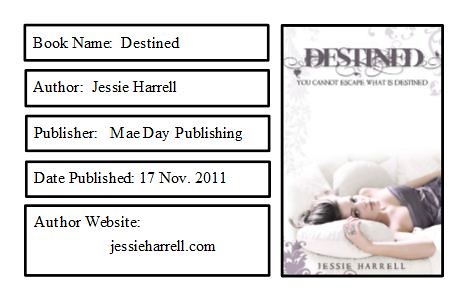
Destined by Jessie Harrell


Destined Bookplate

When Psyche receives a prophecy gone horribly wrong, she learns that even the most beautiful girl in Greece can have a hideous future. Her fate? Fall in love with the one creature even the gods fear. As she feels herself slipping closer into the arms of the prophecy, Psyche must choose between the terrifyingly tender touch she feels almost powerless to resist and the one constant she's come to expect out of life: you cannot escape what is destined.
The first thing I noticed about this book is that it was self-published. Not because it was badly written, though, but because of its design. The pages are set so that lines disappear into the ditch of the book, making it really hard to read. I hate opening my books so much that the pages bend (and I had to, the spine of the book was so hard that I couldn’t break it to read the pages even if I wanted to). There were also some formatting errors in the second half of the book. However, the book is worth powering through the printing flaws because the writing has much fewer problems than the typesetting. Psyche and Eros were really brought to life in this book. Even Aphrodite in her wrath and Iris in her jealousy are relatable and convincing. The plot closely follows the Greek myth, but Harrell fills in the blank spots in between the sentences with a wonderful subtext that helps the reader to really feel the love between Psyche and Eros flower and bloom. Even Psyche’s doubts follow a logical progression, and convincingly interjecting doubt into a growing love plot can be a very hard thing to do. I hope Harrell continues to write, and I will certainly pick up her next book when she writes it.

13 January 2012

Nightspell by Leah Cypess


Here be ghosts, the maps said, and that was all.

In this haunted kingdom, ghosts linger—not just in the deepest forests or the darkest caverns, but alongside the living, as part of a twisted palace court that revels all night and sleeps through the daylight hours.

Darri's sister was trapped in this place of fear and shadows as a child. And now Darri has a chance to save her sister... if she agrees to a betrothal with the prince of the dead. But nothing is simple in this eerie kingdom—not her sister, who has changed beyond recognition; not her plan, which will be thrown off track almost at once; and not the undead prince, who seems more alive than anyone else.

In a court seething with the desire for vengeance, Darri holds the key to the balance between life and death. Can her warrior heart withstand the most wrenching choice of all?


Nightspell is a book about ghosts. Sorcerers in a country where everyone wanted the throne and assassination was a matter of course created a spell that allowed murdered people to come back as semi-corporeal beings in order to avenge their deaths. Although the idea was that they would avenge their deaths and thus move on, eliminating the rash of murders, instead people quickly exploited the spell in order to live forever and murder became not such a big deal since murdered people lived on. Cypess has fully fleshed out this world and spent a lot of time thinking about the consequences and unintended effects of her choices. The result is an eerie, rather uncomfortable place that made me want to move on and yet I had to keep reading in order to find out how Darri would save Callie and get out. And, speaking of, Darri is a strong character. She has a sense of self and loyalty but her regrets have turned her into an avenger herself, interested only in righting the wrong she committed when she let her father send Callie away to marry Prince Kestin. Callie starts out a little confusing, but I grew to really like and sympathize with her. Varis was a jerk, but he was a well written jerk, and much more understandable and sympathetic than Viserys Targaryen from A Game of Thrones (which, for some reason, my mind wouldn’t let me stop thinking of whenever he was in the picture). The plot is so full of twists that I feel I can’t talk much about it, other than saying that I really liked the ending and although I feel it should have turned out the other way I can really see why it turned out why it did and I agree that it’s much more in character, I am just wistful for the ‘what if’ that’s left unsaid. In fact, my only disappointment with this book is that it wasn’t a sequel to Cypess’ excellent first book. I’ll be sure to pick up anything she writes in the future and give it a try.

07 November 2011

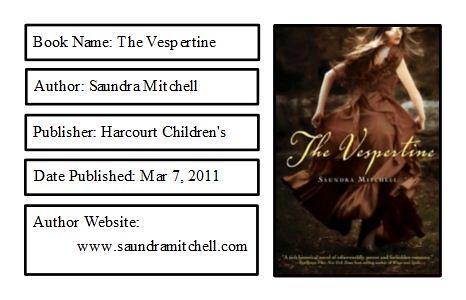
The Vespertine by Saundra Mitchell


It’s the summer of 1889, and Amelia van den Broek is new to Baltimore and eager to take in all the pleasures the city has to offer. But her gaiety is interrupted by disturbing, dreamlike visions she has only at sunset—visions that offer glimpses of the future. Soon, friends and strangers alike call on Amelia to hear her prophecies. However, a forbidden romance with Nathaniel, an artist, threatens the new life Amelia is building in Baltimore. This enigmatic young man is keeping secrets of his own—still, Amelia finds herself irrepressibly drawn to him.

When one of her darkest visions comes to pass, Amelia’s world is thrown into chaos. And those around her begin to wonder if she’s not the seer of dark portents, but the cause.


I feel really sad about this book because it was beautiful and well written and yet I didn’t like it at all. I think it’s really a romance book with an emphasis on historical society and a small dash of paranormal, and romance and societal intrigues really don’t do it for me. It’s too bad, though, because the book deserves some love. Amelia is a character that draws you in and makes you want to understand her. She’s in a new place and experiencing society for the first time, and Mitchell does a great job of showing you life through her eyes and with her particular viewpoint to color the explanations. Zora is a perfect foil, adventurous enough to draw Amelia into some plot-twisting situations as well as encourage her romance. I didn’t like the two paramours, Nathaniel or Thomas, as much as I did the girls. They felt a little flat and the romances seemed based on fluff rather than a solid grounding of connection, however, Mitchell does provide a seeming that this is how romance is done in the world of 1889 society so it seems less realistic and more juvenile and sad. I was a little skeptical of the twist ending, it seemed a little too abrupt and manufactured, but the journey of the book was so good that I’m willing to excuse it. I just hope this book finds love with others, because it deserves some love but I just can’t give it.

03 November 2011

Cleopatra’s Moon by Vicky Alvear Shecter


"The Luxe" meets the ancient world in the extraordinary story of Cleopatra's daughter. Selene has grown up in a palace on the Nile with her parents, Cleopatra & Mark Antony—the most brilliant, powerful rulers on earth. But the jealous Roman Emperor Octavianus wants Egypt for himself, & when war finally comes, Selene faces the loss of all she's ever loved. Forced to build a new life in Octavianus's household in Rome, she finds herself torn between two young men and two possible destinies—until she reaches out to claim her own. This stunning novel brings to life the personalities & passions of one of the greatest dramas in history, & offers a wonderful new heroine in Selene.


I know, I’m really stretching the idea of “fantasy” with this book. It’s really more of a fictional biography, but I’m gonna claim fantasy because there is one scene where Cleopatra Selene casts a spell and communes with a goddess.

I really liked this book. It cast the world of Ptolemaic Egypt in a new light for me and gave a new face to the legendary characters. Selene is a great character. I thought her determination and will were a great trait that she shared with her mother. At first I was a little surprised that she also didn’t share her mother’s legendary sexuality as a manipulation tool, but the book does a very good job at presenting Selene as not only adapting to survive but also rejecting the parts of her mother that she thinks led to her downfall. The romance in the book is barely there, but this is not a bad thing. Selene’s life is adventurous enough, and just staying alive takes up much of her time. The plot closely followed history, but it flowed very well and only seemed forced near the end where history took a strange turn that the author didn’t connect to the rest. That end was rather abrupt and out of character for Selene, and I feel it could have been better written so that it flowed better and fit the rest of the book. I forgive it, though, because it did make me happy about leaving her in a good place. In all I feel that this book is totally worth reading.