29 March 2011

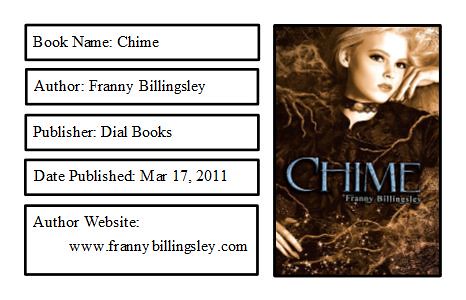
Chime by Franny Billingsley


Briony knows she is a witch. She knows that she is guilty of hurting her beloved stepmother. She also knows that, now her stepmother is dead, she must look after her beautiful but complicated twin sister, Rose. Then the energetic, electric, golden-haired Eldric arrives in her home town of Swampsea, and everything that Briony thinks she knows about herself and her life is turned magically, dizzyingly, upside down.


This book was simply excellent. It's already my fave for the month, and it's up there with Across the Universe for one of my faves of the year. It's strange, though, because for the first few pages I was a bit confused. I thought that Briony's voice, especially, was flat and rather dead. However, as the book went along I realized that Briony had a distinct, beautiful voice, and that she had convinced herself that she wasn't allowed to feel. The lack of feelings contributed to the "dead"ness of her tone, but somehow Briony snuck through that dead tone, shining as a character even through all her attempts to stifle herself and her life. This subtlety of craft in writing really shone and made this book spectacular. Not that it needed a ton of help: the plot is very Grimm-esque with its darkness and its magic, the other characters are unique and believeable, and the plot twists are exciting and yet not insane. Billingsley is also excellent at portraying Rose, and her madness is dealt with in a very refreshing manner. Rose is a girl who is mad, not a madness that needs a name, and it is nice to see a mentally handicapped character 1) represented as a major character in a book, and 2) handled in such a human manner. The romance between Briony and Eldric is well-handled, and the love triangle provides a great contrast for the emotion that Briony tries very hard to bury. It's a great example of love, too, because it develops in a natural manner and we can see Briony's fondness growing even through her icy facade.


**spoiler**


**spoiler**


**spoiler**


I think my only downside to this book is that I figured out the final twist early, and not because of the writing, but because of the title. Please, no more spoilers in titles!

27 March 2011

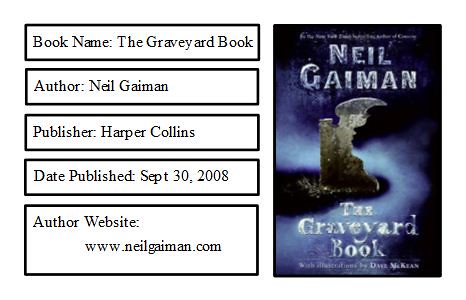
The Graveyard Book by Neil Gaiman


Bod is an unusual boy who inhabits an unusual place-he's the only living resident of a graveyard. Raised from infancy by the ghosts, werewolves, and other cemetery denizens, Bod has learned the antiquated customs of his guardians' time as well as their timely ghostly teachings-like the ability to Fade. Can a boy raised by ghosts face the wonders and terrors of the worlds of both the living and the dead? And then there are things like ghouls that aren't really one thing or the other. This chilling tale is Neil Gaiman's first full-length novel for middle-grade readers since the internationally bestselling and universally acclaimed Coraline. Like Coraline, this book is sure to enchant and surprise young readers as well as Neil Gaiman's legion of adult fans.


This Hugo and Newberry Award winning book is worth all the critical acclaim. The plot is a great one: a young boy escapes death by assassin to become the ward of ghosts in a cemetery. He has to endure figuring out who he is while also dealing with being raised by ghosts, knowing he is different, and not being allowed to leave the cemetery. Bod is a great character, too. I think he's totally believable as a person who was raised by ghosts in a cemetery. I like how he reaches out to Scarlett and the "unacceptable" ghosts. I also liked the drive in Jack, although I did feel that his storyline was left unresolved. Silas and Miss Lupescu are great guardians, and I love how Miss Lupescu is the typical English "horrid babysitter" while breaking the stereotype because she's a fighter interested in the occult. The only other female in this book, Death, is intriguing because it is not often you see death personified as female, but the mysterious "Lady on the Grey" is seen as the overseer and ruler of all the ghosts, yet she remains mysterious and aloof so all the mystique of death is still intact. This is a difficult balance to find in a book that goes so in depth about the afterlife. I do wish we had seen more of the Owens because they didn't seem very parental, but I think this is because we didn't really see them in parental stages in Bod's life, so I'm ok with it. In all, the book was pretty perfect, and I wouldn't hesitate to hand it to any twelve year old I know.

18 March 2011

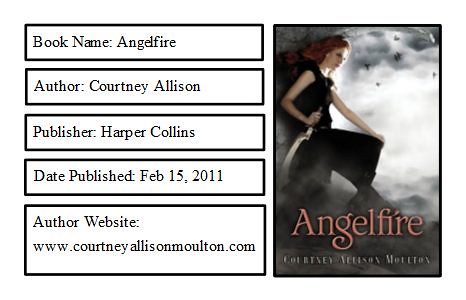
Angelfire by Courtney Allison Moulton


When seventeen-year-old Ellie starts seeing reapers - monstrous creatures who devour humans and send their souls to Hell - she finds herself on the front lines of a supernatural war between archangels and the Fallen and faced with the possible destruction of her soul.

A mysterious boy named Will reveals she is the reincarnation of an ancient warrior, the only one capable of wielding swords of angelfire to fight the reapers, and he is an immortal sworn to protect her in battle. Now that Ellie's powers have been awakened, a powerful reaper called Bastian has come forward to challenge her. He has employed a fierce assassin to eliminate her - an assassin who has already killed her once.

While balancing her dwindling social life and reaper-hunting duties, she and Will discover Bastian is searching for a dormant creature believed to be a true soul reaper. Bastian plans to use this weapon to ignite the End of Days and to destroy Ellie's soul, ending her rebirth cycle forever. Now, she must face an army of Bastian's most frightening reapers, prevent the soul reaper from consuming her soul, and uncover the secrets of her past lives - including truths that may be too frightening to remember.


Angel books, why do I keep reading you even though I'm usually disappointed? Perhaps one of these days I will learn my lesson. Books like Angelfire make it hard to learn, though. There was a lot to like in this book. The plot and idea were fresh and new, and I was excited to see how the mythology was woven into the book in exciting ways. I liked the strong female fighter angle, although it did seem like she was still weaker than Will and Nathaniel, but that can be excused away by the fact that she's not fully aware yet of who she is and how to work what she's got. It's also not like she had much training prior to starting to fight monsters. Will and Nathaniel both seem like rounded characters, and although Will comes off a little Edward-esque his angles and issues are fresh and more rounded and modern and I like him for them. The relationship between Ellie and Will was the best aspect of this book. It was understandable, age-appropriate, and felt very realistic to me. I thought that the Logan-love-triangle was weak, but I don't think I would have wanted him in any more of the book, so I count that as a good aspect as well.

On the other hand, although I liked the plot and Will the human characterization felt off to me. Ellie reads as ageless even before she is *awakened*. Yet she also reads as reckless. Perhaps this is a result of the author trying to interweave Ellie's young age with her immortality, but it just didn't work for me. I also didn't get the point of Ellie's father being characterized as an abuser. It really seemed like a plot point in the making, but it ended up going nowhere. I did like Ellie's mother, although in the last chapter of the book she seemed rather preachy. Then again, she had a lot to be preachy about, which is my main problem with this book. Ellie does a lot of things that are, in my opinion, wrong. She lies. She drinks. She runs away to other countries without telling her parents. And yet there's really no consequences for any of these actions. I'd expect the author to at least address that drinking would slow a fighter's reaction time, but although Ellie is portrayed as plastered in the scene she still manages to fight unhindered. I found these things both unrealistic and disturbing, especially considering the big reveal at the end and what Ellie really is. However, even if Ellie was completely human I wouldn't approve, either. I didn't like Kate and her issues with these either. However I'm not sure that issue is enough that I'd not recommend this book to an adult or a mature teen. If there are more books in the series I will be sure to get them.

I was provided with a free copy of this book through NetGalley, but I also went out and purchased a hard copy for my library.

15 March 2011

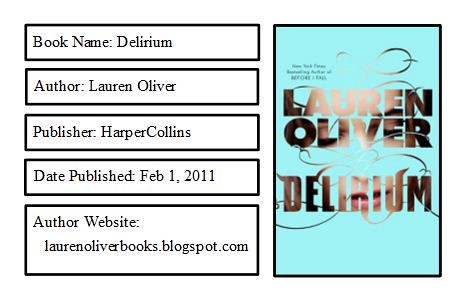
Delirium by Lauren Oliver


They say that the cure for love will make me happy and safe forever. And I’ve always believed them.

Until now.

Now everything has changed. Now, I’d rather be infected with love for the tiniest sliver of a second than live a hundred years smothered by a lie.


From bestselling author Lauren Oliver comes the first book in a stunning new trilogy set in a dystopian world. Prepare to be captivated!


Although this book was technically spectacular, I really didn't like it. I think if I were a teenager, though, I would love it. This is really one of those rare books that wasn't able to cross the age gap in my head. It's sad, really, that I've got such a mental block against it because this book had a lot of things going for it. Lena is an amazing character. She is a mature teenager, with all the layered nuances that goes along with that. She's not an adult with a younger body but mature thought processes, and yet she's also not an adult's construction of a teenager's brain. From what we see of him Alex is well thought out as well. His actions and reactions are typical of a teenage boy discovering relationships. With a little imagination the dystopian world created is believable as well (that is, if you can buy into the unspoken inference that emotionless people are easier to bend to your will).

However, two things stuck out to me as odd in this book. The characters imply that the "cure" takes away all emotions. Now, granted that we haven't actually experienced the cure in a major character, just Lena's mixed views of it. However, it seems odd to me that the operation doesn't "cure" rage, suspicion, and terror. I guess I was expecting a society of vulcans, and the result is stranger because people have negative emotions without the balance of positive ones. Perhaps this is because Oliver is better versed in brain mapping and capabilities than I am, and it is in fact possible to separate the two in the brain. I'd really like them to explain, however, why they left the negative emotions alone instead of excising them all.

The other issue I had with this book, and the major one from my point of view, was the representations of love. Oliver presents a very one-sided, teenage view of love. There's not much separation of passion from love, there's no exploration of long-term devotion, and there's little more shown outside of love-at-first-sight sparks and fireworks. Even Lena's mom is presented as loving Lena's Dad too much to go on living without him, even with the 'love' she was capable of feeling towards her children (which is illustrated well in a story, but not explained). It's also not explored as a layered issue. Lena's mother killed herself because she missed Lena's father, not because she had endured two sessions of brain surgery and was facing a third, or that her government viewed her as "subversive" and a criminal, or that she had to hide her true self and live in a constant state of fear, or that . . . well, we'll just stop there, I think you get the picture. My only hope is that the book is planned as the first of a trilogy, so perhaps these are issues that the author will get to in time and I'm just too impatient. I will probably pick up the next book for the series-completionist in me, but I'm not sure I'd recommend this book to other people.

07 March 2011

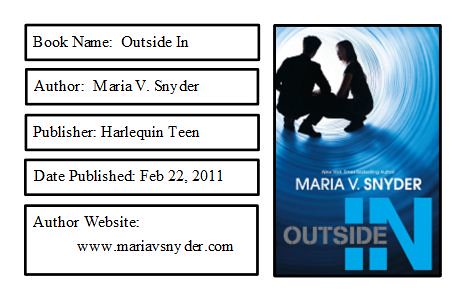
Outside In by Maria V. Snyder


Me?? A Leader??

Okay, I did prove that there's more to Inside than we knew. That a whole world exists beyond this cube we live in. And finding that led to a major rebellion-between worker scrubs like me and the snobby uppers who rule our world. Make that ruled. Because of me, we're free. I thought that meant I was off the hook, and could go off on my own again-while still touching base with Riley, of course. He's the one upper I think I can trust. But then we learned that there's outside and then there is Outside. And something from Outside wants In.


As I said in the review for Inside Out, this book's predecessor, I read both these books in less than a day because they were that good. My e-copy of Outside In was provided to me free by the publisher through NetGalley.

Like most dystopian series Outside In deals with the chaos of rebuilding a world after the status quo has been toppled. Trella is still a delight in this book, and I like how she deals with the consequences of her actions . . . or doesn't deal with them, which is much more true to her character. While you see growth in her, and in all the characters, it is slow, believable growth that doesn't destroy Trella's spark that made you like her. The rest of the characterizations are good as well. Trella's relationship with Doctor Lamont is beautiful on both ends, with the characters acting and reacting to eachother in ways that are as emotionally vivid as they are realistic. The relationship between Trella and Riley is similarily good, even if it does seem a little mature, reasoned, and adult for a first relationship.


**Spoiler Alert**

I think if I had to complain about anything in this book it would be the beings of Outside. The Outsiders are never fully explained, especially their differences, and I'm left thinking they are a little too overpowered and convenient for the plot. However, they don't destroy the story, they just leave behind some nagging questions. I'm not going to totally discount the book for their presence, but I'm hoping that the sequel will explain their history and alternate development a little bit more instead of springing so much on us at once.